

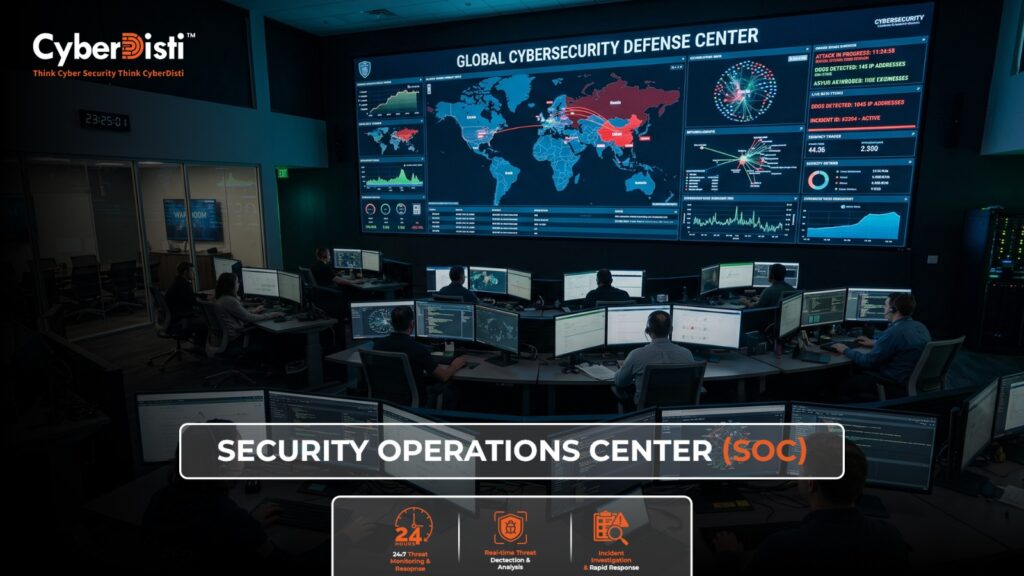
Security Operations Center (SOC): What It Is, How It Works & Why It Matters in 2026
Introduction
Cyber threats are evolving faster than ever. For modern businesses, the question is no longer if an attack will happen—but when.
This is where a Security Operations Center (SOC) becomes critical.
A SOC acts as the central hub for monitoring, detecting, and responding to cyber threats in real time—helping organizations stay protected 24/7.
With the support of trusted partners like CyberDisti, a leading cybersecurity distributor, businesses can implement advanced SOC solutions more efficiently.
What is a Security Operations Center (SOC)?
A Security Operations Center (SOC) is a centralized function within an organization that continuously monitors and improves its security posture.
It combines:
- People – Security analysts and threat hunters
- Processes – Structured workflows for incident detection and response
- Technology – Tools like SIEM, EDR, and XDR
Together, these elements form a powerful SOC solution designed to detect and respond to threats before they cause damage.
How Does a SOC Work in Cybersecurity?
A SOC operates through a continuous lifecycle:
Data Collection
Logs and data are gathered from endpoints, networks, servers, and applications.
Threat Detection
Advanced tools like SIEM and EDR identify suspicious patterns and anomalies.
Investigation
Security analysts analyze alerts to determine if they are genuine threats.
Incident Response
Immediate action is taken to contain and eliminate threats.
Recovery & Reporting
Systems are restored, and reports are generated to improve future security.
This cycle enables real-time protection and strengthens overall cybersecurity resilience.
Why Businesses Need SOC Solutions in 2026
As cyberattacks become more sophisticated, relying solely on traditional security tools is no longer enough.
Without a SOC
- Threats go undetected for long periods
- Data breaches escalate quickly
- Response is slow and reactive
- Compliance risks increase
With a SOC
- 24/7 SOC monitoring ensures continuous protection
- Faster threat detection and response
- Reduced downtime and financial impact
- Improved compliance and reporting
- Stronger customer trust
Many organizations today prefer managed SOC services or SOC as a Service (SOCaaS) to achieve enterprise-grade security without heavy investments—often enabled through providers and distributors like CyberDisti.
Core Functions of a Security Operations Center
- Continuous Monitoring
Round-the-clock monitoring of networks, endpoints, and user activity to detect suspicious behavior.
- Threat Detection and Analysis
Using advanced tools, SOC security services identify and analyze threats early.
- Incident Response
SOC teams act quickly to:
- Isolate affected systems
- Remove threats
- Restore normal operations
- Threat Intelligence
Access to global threat data helps identify emerging attack patterns and vulnerabilities.
- Log Management
All system activities are recorded and analyzed for better visibility and security improvements.
- Compliance and Reporting
Ensures adherence to standards such as:
- ISO 27001
- GDPR
- HIPAA
Types of SOC Models
In-House SOC
Built and managed internally, offering full control but requiring significant investment and expertise.
Managed SOC
Delivered by a SOC service provider, offering scalability, cost efficiency, and access to expert teams.
Hybrid SOC
A combination of internal resources and external providers for flexibility and control.
SOC vs MDR: Understanding the Difference
- SOC (Security Operations Center)
A complete security framework combining people, processes, and tools
- MDR (Managed Detection and Response)
A service that provides SOC capabilities
👉 In simple terms, MDR can be considered SOC-as-a-service
Challenges in Building a SOC
Organizations often face several challenges when building a SOC:
- High setup and operational costs
- Shortage of skilled professionals
- Alert fatigue from excessive notifications
- Integration complexities across tools
- Rapidly evolving threat landscape
Because of these challenges, many businesses turn to managed SOC providers and trusted cybersecurity distributors like CyberDisti, one of the best cybersecurity distributors, for guidance and deployment support.
Benefits of Managed SOC Services
Partnering with a managed SOC provider offers:
- Lower operational costs
- Faster deployment
- Access to cybersecurity experts
- Advanced detection technologies
- Continuous security improvements
Conclusion
In today’s digital landscape, cybersecurity requires constant monitoring, rapid response, and strategic intelligence.
A Security Operations Center (SOC) enables organizations to:
- Detect threats early
- Respond effectively
- Minimize damage
- Maintain compliance
Adopting the right SOC solutions—with support from experienced partners like CyberDisti—helps businesses move from reactive security to a proactive defense strategy.